
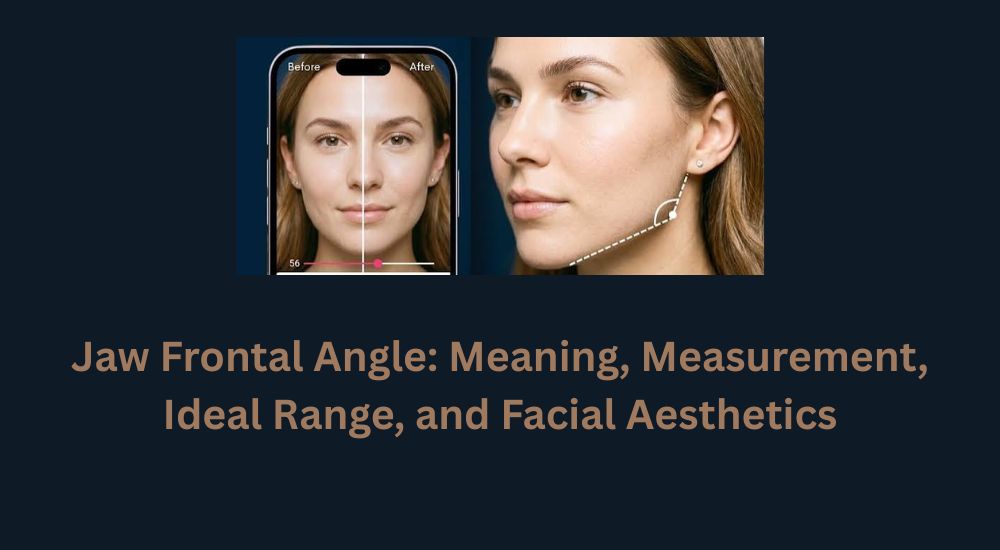
The jaw frontal angle is a facial measurement used to describe the shape and taper of the lower jaw when the face is viewed from the front. It helps show whether the lower face appears more tapered toward the chin or broader and squarer.
Unlike the gonial angle, which is measured from a side profile, the jaw frontal angle is calculated from a frontal view. It focuses on the direction of the lower jaw borders as they extend from the jaw corners toward the chin.
This measurement has become more popular through facial-analysis tools and online discussions about facial proportions. However, an important point is that there is no single universally accepted “perfect” jaw frontal angle for every person. Different analysis systems can use different landmarks, formulas, and reference ranges.
What Is the Jaw Frontal Angle?
The jaw frontal angle describes the relationship between the left and right lower borders of the jaw when viewed from the front.
In a typical facial-analysis construction, lines are drawn along the lower jaw borders and extended toward the center below the chin. The resulting angle describes how strongly the jaw tapers toward the chin.
A smaller angle generally represents a more tapered or V-shaped lower face in this particular measurement system. A larger angle generally represents flatter jaw borders and a broader, squarer lower-face appearance.
The measurement therefore tells us more about lower-face taper than simply measuring how wide the jaw is.
Jaw Frontal Angle vs. Gonial Angle
These two terms are easy to confuse, but they are not the same measurement.
| Measurement | View | What it describes |
| Jaw frontal angle | Front | Taper and direction of the lower jaw borders |
| Gonial angle | Side | The angle formed around the back corner of the mandible |
| Bigonial width | Front | Width between the jaw-angle landmarks |
| Jaw slope | Front | The steepness of the lower jaw border |
The gonial angle is a side-profile measurement. It involves the ramus and lower border of the mandible.
The jaw frontal angle, by comparison, is a frontal facial measurement. FaceIQ specifically distinguishes the frontal jaw measurement from the side-profile gonial angle.
This distinction matters because a person can have a strong-looking jaw from the front while having a different gonial angle from the side.
How Is Jaw Frontal Angle Measured?
The jaw frontal angle is measured from a front-facing facial image.
A facial-analysis system first identifies landmarks around the lower jaw. The measurement then follows the directions of the left and right lower jaw borders. These lines are extended to create the frontal angle.
The exact result depends on the landmarks and formula used by the particular analysis system.
For example, FaceIQ describes its calculation as:
180° minus the angle between the two gonion-to-chin-border directions.
This means that two different facial-analysis tools can potentially produce different results from the same photograph if they use different landmark definitions or calculations.
What Does the Jaw Frontal Angle Tell You?
The main purpose of the measurement is to describe how the lower face tapers toward the chin.
A lower value in the commonly used construction generally indicates more sharply descending jaw borders. This can contribute to a more tapered lower-face appearance.
A higher value generally indicates flatter jaw borders. This can make the lower face appear broader or more square.
However, the jaw frontal angle should never be viewed by itself.
The appearance of the jaw also depends on:
- Jaw width
- Chin width
- Chin projection
- Jaw definition
- Facial width
- Body-fat level
- Soft-tissue thickness
- Facial symmetry
- Head position
- Camera angle
Therefore, one angle cannot completely describe the appearance of someone’s jaw.
What Is the Ideal Jaw Frontal Angle?
One commonly cited facial-analysis reference range is approximately 86.5° to 92.5°. RateMyFaceAI uses this as its default reference band for both men and women.
However, this range should not be treated as a universal scientific rule.
The website itself explains that its range is a reference band used by its analysis system, rather than a population average or universal standard of attractiveness.
This distinction is important.
Facial proportions vary naturally between individuals and populations. A person can have a jaw frontal angle outside a particular software’s preferred range and still have balanced or attractive facial features.
Is 90 Degrees a Good Jaw Frontal Angle?
Around 90° falls within the 86.5°–92.5° reference range used by some facial-analysis systems.
For that reason, a result close to 90° is often described as being within a preferred range in online facial-harmony analysis.
But it would be inaccurate to say that exactly 90° is scientifically proven to be the perfect jaw frontal angle.
Facial attractiveness is influenced by many features working together. The relationship between the jaw, cheekbones, chin, eyes, nose, and overall facial proportions can matter more than a single number.
What Does a Low Jaw Frontal Angle Mean?
A lower jaw frontal angle generally indicates that the lower jaw borders create a more tapered shape in the particular measurement system being used.
From the front, this can contribute to a V-shaped or narrower lower-face appearance.
However, a lower number is not automatically better.
If the angle is very narrow, the jaw may appear highly tapered. Whether that looks balanced depends on the person’s other facial proportions.
The width of the chin is especially important because a narrow chin combined with strongly tapered jaw borders can create a different visual effect than the same angle with a wider chin.
What Does a High Jaw Frontal Angle Mean?
A higher jaw frontal angle generally indicates flatter lower-jaw borders.
This can contribute to a wider or squarer appearance in the lower face.
Again, higher does not automatically mean better or worse.
A wider jaw can be an important part of a strong or angular facial appearance, especially when it is balanced with the cheekbones and chin.
This is why facial analysis should consider the entire structure instead of ranking one measurement in isolation.
Jaw Frontal Angle and V-Shaped Faces
The jaw frontal angle is closely related to the way the lower face tapers.
A more tapered jaw can contribute to a V-shaped facial appearance, while flatter jaw borders can contribute to a squarer appearance.
However, the angle alone does not determine face shape.
Two people can have a similar jaw frontal angle but look quite different because their:
- Cheekbones have different widths
- Chins have different shapes
- Faces have different heights
- Jaws have different widths
- Soft tissues have different thicknesses
Facial shape is therefore a combination of several measurements rather than a single angle.
Jaw Frontal Angle and Jaw Width
The jaw frontal angle should also be separated from bigonial width.
Bigonial width measures the distance between the two jaw-angle landmarks. The jaw frontal angle describes how the lower jaw borders are oriented toward the chin. Both are front-view measurements, but they answer different questions.
For example, someone can have a relatively wide jaw but still have a tapered lower-face shape.
Another person may have a narrower jaw with relatively flat borders.
This is why looking at jaw width alone cannot tell you what the frontal jaw angle is.
Jaw Frontal Angle and Chin Shape
The chin plays an important role in how the jaw frontal angle looks.
A wide chin can make the lower face appear broader, while a narrow chin can emphasize tapering.
Because the frontal jaw measurement uses the direction of the jaw borders toward the chin, changes in chin width and jaw-corner position can influence the resulting angle.
This means that two people with similar jaw angles may still have very different-looking chins and jawlines.
Can You Measure Jaw Frontal Angle From a Photo?
Yes, a frontal photograph can be used to estimate the measurement if the face is positioned correctly and the appropriate anatomical landmarks can be identified.
Facial-analysis systems use landmarks such as the jaw corners and chin to calculate facial measurements.
However, an ordinary selfie may not produce a reliable result.
Factors such as camera distortion, head rotation, facial expression, lighting, lens distance, and image quality can affect landmark placement.
For the most consistent measurement, the face should be positioned straight toward the camera with a neutral expression and minimal perspective distortion.
How to Measure Jaw Frontal Angle at Home
If you want to estimate your jaw frontal angle from a photograph, start with a clear straight-on image.
Step 1: Use a Front-Facing Photo
Choose a photograph where the person’s face is looking directly toward the camera.
Avoid photos taken from above, below, or at an obvious horizontal angle.
Step 2: Keep the Head Straight
The head should not be tilted or rotated.
Even a small rotation can make one side of the jaw appear different from the other.
Step 3: Identify the Jaw Corners
Locate the left and right points around the corners of the lower jaw, commonly referred to as the gonion landmarks in facial analysis.
Step 4: Identify the Chin Area
Locate the central chin landmark and follow the lower jaw borders toward it.
Step 5: Extend the Jaw Lines
Draw or extend the two jaw-border directions according to the measurement method being used.
Step 6: Calculate the Angle
Measure the resulting angle according to the chosen formula.
The exact calculation should match the system or methodology you are following because different systems may define the construction differently.
Why Different Tools Give Different Jaw Angles
It is possible for two facial-analysis tools to produce different jaw frontal angle measurements from the same face.
This can happen because the systems may use:
- Different facial landmarks
- Different landmark-placement methods
- Different formulas
- Different image-processing models
- Different reference planes
- Different definitions of the jaw border
FaceIQ, for example, explicitly describes its own landmark-based construction and notes that its specific score and reference ranges are model settings rather than a universal validated attractiveness standard.
Therefore, when comparing measurements, you should use the same methodology rather than mixing numbers from unrelated systems.
Is Jaw Frontal Angle Important for Facial Attractiveness?
The jaw frontal angle can contribute to how the lower face is perceived, but it is only one part of facial appearance.
Facial-analysis systems typically examine many other measurements, including facial width-to-height ratio, cheekbone position, chin proportions, eye measurements, nose proportions, and jaw width.
This is important because facial attractiveness is not determined by a single mathematical number.
A balanced face can have measurements that do not fall into a particular online “ideal” range.
In other words, a jaw frontal angle should be interpreted as a descriptive facial measurement, not as a definitive score of beauty.
Jaw Frontal Angle vs. Jaw Slope
Jaw frontal angle and jaw slope are also different measurements.
The jaw frontal angle describes the relationship between the two lower jaw borders from the front.
The jaw slope measures how the cheek-to-jaw-side line meets the lower jaw border. FaceIQ lists both measurements separately in its front-jaw analysis.
This means that knowing one measurement does not tell you the other.
A complete facial analysis can use both to provide a more detailed description of lower-face structure.
Can Jaw Frontal Angle Change?
The underlying bone structure of an adult jaw does not normally change dramatically without a significant physical or medical intervention.
However, the measured appearance can change because of soft tissue, facial weight, aging, posture, expression, and photography.
For example, changes in facial fullness can make the jawline look sharper or softer even if the underlying bone has not changed.
Likewise, turning the head slightly can change the apparent direction of the jaw borders in a photograph.
Therefore, measurements taken from different photographs should be compared carefully.
Does Weight Affect Jaw Frontal Angle?
Body weight does not normally change the bony angle itself in a simple or predictable way.
However, changes in facial soft tissue can affect how clearly the jaw borders are visible.
A leaner face may reveal the underlying jawline more clearly, while increased facial fullness can make the jaw appear softer.
This means that the visible definition of the jaw can change even when the underlying skeletal angle remains the same.
Jaw Frontal Angle in Men and Women
The measurement itself can be calculated in both men and women.
However, facial proportions can vary by sex, ancestry, age, and individual structure. Some facial-analysis systems therefore use different reference settings or ranges for different groups.
This is another reason why one number should not be described as the perfect jaw frontal angle for every person.
The same measurement can also produce a different visual impression depending on the rest of the face.
Does a Smaller Angle Mean a Better Jaw?
No.
A smaller jaw frontal angle can produce a more tapered lower face, but that does not automatically make the face more attractive.
A larger angle can create a broader or squarer jaw, which may also be considered aesthetically desirable.
The best-looking result depends on overall facial harmony rather than one isolated measurement.
Even facial-analysis websites that provide preferred ranges describe their ranges as system-specific references rather than universal standards.
Jaw Frontal Angle Reference Range
For quick reference, one commonly cited facial-analysis system uses:
| Jaw frontal angle | General interpretation |
| Below 86.5° | More tapered than that system’s reference band |
| 86.5°–92.5° | Within the cited reference band |
| Above 92.5° | Flatter or broader than that reference band |
These descriptions should be treated as general interpretations of one reference system, not medical classifications or universal beauty rules.
Other systems can use different ranges, so the number should always be interpreted together with its measurement method.
Conclusion
The jaw frontal angle is a front-view measurement that describes how the lower jaw borders taper toward the chin. It should not be confused with the gonial angle, which is measured from the side profile. Some facial-analysis systems cite 86.5°–92.5° as a preferred reference range, but this is not a universal medical or beauty standard.
The most useful way to understand the measurement is as one part of overall facial structure. Jaw width, chin shape, cheekbones, facial proportions, soft tissue, and symmetry all contribute to how a jaw actually looks. Therefore, the jaw frontal angle can provide useful geometric information, but it should never be treated as the sole measure of an attractive or well-balanced face.
Frequently Asked Questions About Jaw Frontal Angle
What is a jaw frontal angle?
Jaw frontal angle is a front-view facial measurement describing the relationship between the left and right lower jaw borders as they extend toward the chin.
What is the ideal jaw frontal angle?
Some facial-analysis systems use approximately 86.5° to 92.5° as a reference range, but there is no universal scientifically established ideal for everyone.
Is jaw frontal angle the same as gonial angle?
No. Jaw frontal angle is measured from the front, while the gonial angle is a side-profile measurement involving the corner of the mandible.
Does a lower jaw frontal angle mean a sharper jaw?
Generally, a lower value in this measurement corresponds to more tapered jaw borders and can contribute to a V-shaped lower face.
Can jaw frontal angle be measured from a photo?
Yes. It can be estimated from a properly positioned frontal photograph by identifying the relevant jaw and chin landmarks.
Does jaw frontal angle determine facial attractiveness?
No. It is only one facial measurement. Jaw width, chin shape, cheekbones, facial proportions, symmetry, and soft tissue also affect overall facial appearance.
